The Black Diablo Manganese Mine
Location
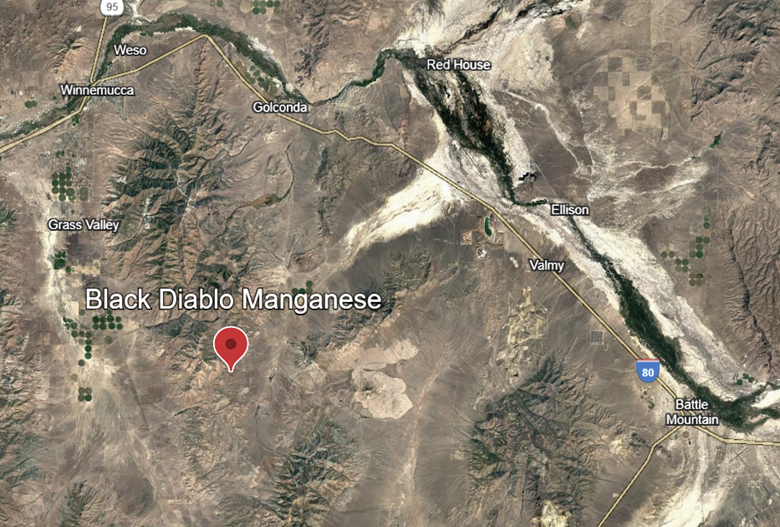
The Black Diablo mining district is located on the Pershing-Humbolt County line on the east side of the Sonoma Range. The major mine, the Black Diablo, is located in S2, T32N, R39E. That mine and a few nearby properties make up the district.
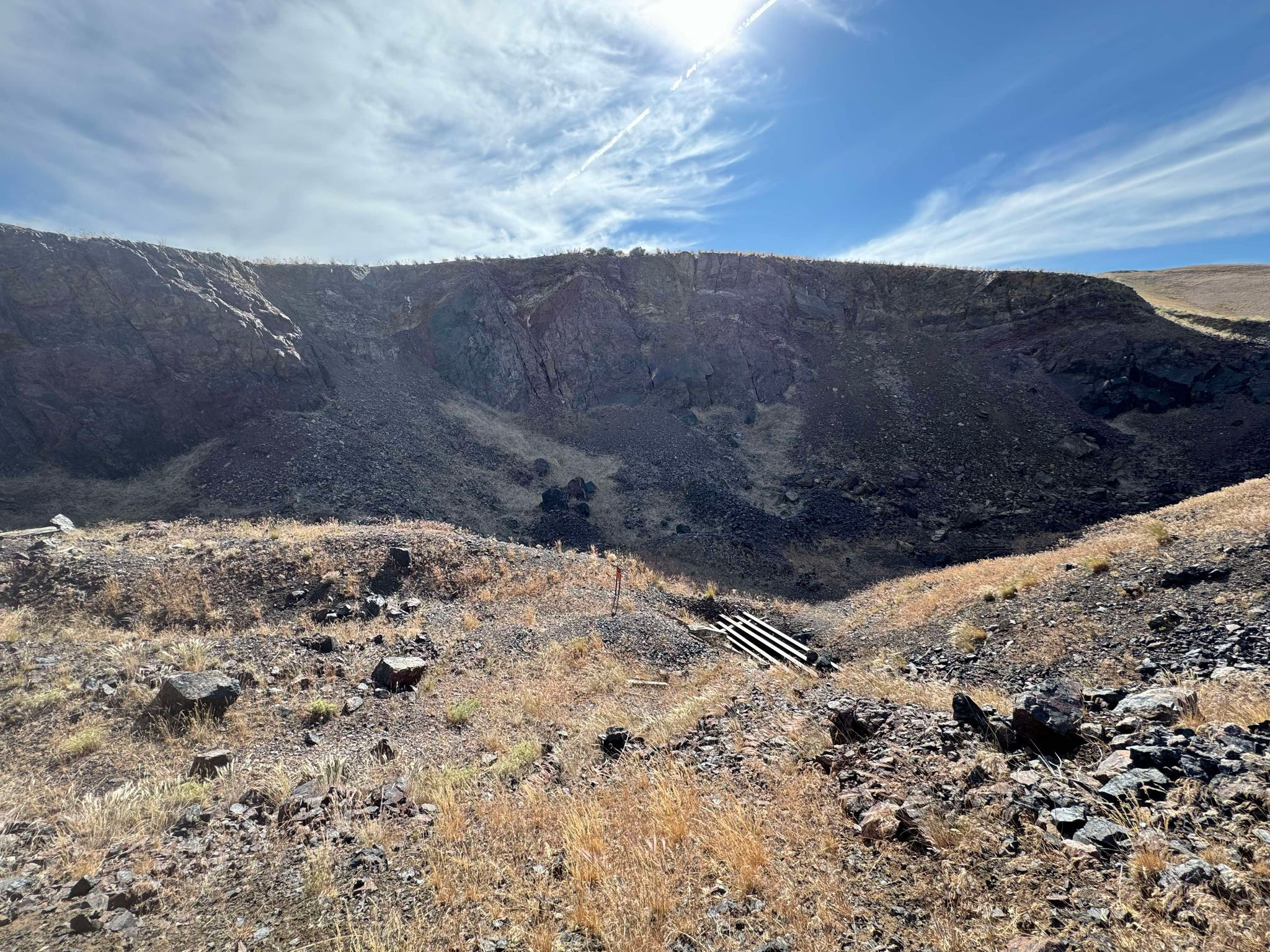
The current claims cover this historical open pit, which is measured to be approximately 30 feet deep and 40 feet in diameter. There is room to claim additional area around the pit for further Manganese or Copper exploration.
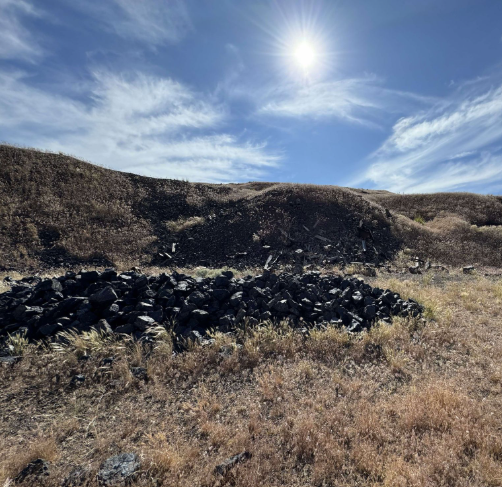
On the property, there are also two historical adits that are caved at the portal and a large dump of material.
History
Manganese deposits have been known in the area since 1900, but no ore was produced until 1929. Johnson (1977, p. 55) reports that the Black Diablo Mine produced most of the manganese mined in Pershing County between 1929 and 1954. Over it’s lifespan, the mine produced over 100,000 tons of Manganese material. The Black Diablo Mine is apparently the same property as the O’Brian and Tucker claims and the De La Vega claims.
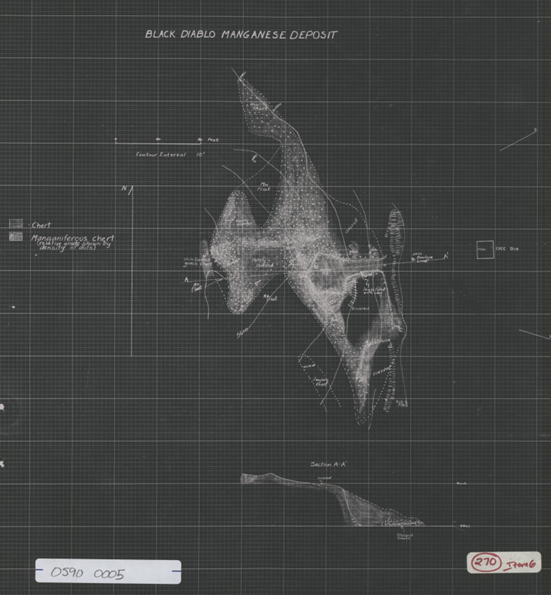
At multiple points throughout history, the Bureau of Mines conducted research on the property. In 1940, exploration identified two separate deposits that parallel the bedding. The main deposit was lenticular and massive, 520 feet long, 160 feet wide at the center, and 6 to 10 feet wide at both ends. The deposit, lying several hundred feet to the northwest, comprised 2 lenses, roughly 40 by 270 feet and 20 by 140 feet. Based on their assessment, the deposit “was the largest and best exposed of any in the group lying south of Golconda in which the principal manganese mineral is braunite. During the first exploration period, 26 trenches, and 8 diamond drill holes were conducted.
Geologic Setting
The manganese deposits in the Black Diablo district are syngenetic deposits in the Pennsylvanian and Permian Pumpernickel Formation, which consists of argillite, chert, and greenstone. The manganese is believed to have been deposited from submarine hot springs.
Ore Deposit
At the Black Diablo Mine, a massive lens of black manganese ore occurs in a sequence of dark greenstone, light gray chert, and olive to maroon argillite. Red jasper occurs above, within, and below the ore zone. The deposit is almost entirely braunite intergrown with chalcedony: small amounts of bementite, rhodenite, and piedmontite occur also, as well as manganese oxides near the surface. The deposit parallels bedding in the Pumpernickel Formation. Nearby manganese properties are reported to be similar to the Black Diablo Deposit, although small in size and of lower grade.
In 1942, the United States Smelting and Refining Company put together a report on identified Manganese Deposits that could theoretically feed their smelting operations across the West. In this report, Black Diablo was reviewed and indicated the following observations:
- At least 75,000 tons of moderate grade material (>30% Mn)
- At least 75,000 tons of lower grade material (5-8% Mn)
- Additional samples for Silica were taken, measuring 54.8% SiO2
Recent Exploration Work
In 2021, the junior exploration company Victory Battery Metals acquired these claims to explore for VMS Copper deposits in the same belt of rocks as the Nevada Sunrise Gold Corp’s Coronada VMS Project immediately to the south. The Big Mike Copper Mine is on this property, about 10 miles to the south.
The Big Mike Copper Mine produced about 25 million pounds of copper in 100,000 tons of ore grading 10.5% copper, which was shipped directly to a smelter in West Germany. Ranchers also carried out heap leaching on the lower-grade disseminated copper ore, treating about 300,000t of mineralized rock.
According to Victory Battery Metals, the Black Diablo Property hosts the Black Diablo Manganese Oxide Mine. Regarding manganese oxide deposits, the USGS notes that (in the Winnemucca area) “permissive and favorable tracts coincide with those of the Cyprus massive sulfide deposits. The Mineral Resource Data System entry for the Black Diablo deposit reports a sample containing 10 000 ppm Cu. Franciscan type Manganese Oxide deposits commonly contain trace copper, suggesting that the Black Diablo is anomalous for copper. As this is an anomalously high amount of Cu for a Manganese Oxide Deposit, it may indicate the area is particularly prospective for Cyprus style VMS deposits such as the Big Mike.